
CANADA: Translation | Indigenous Languages
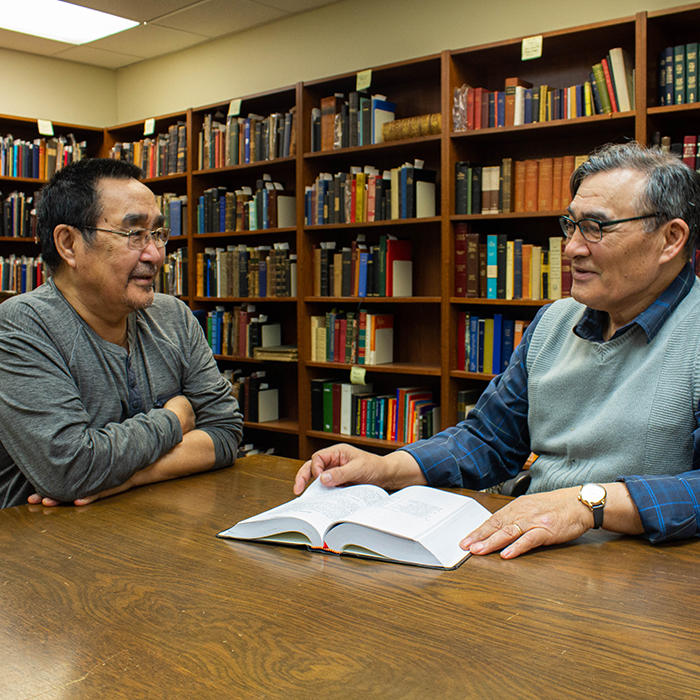
From a position of humility, of affirming hope, and engaging the complexities of reconciliation, we are honoured to be invited to work alongside Indigenous Canadians for the good of their communities.
In many Indigenous Canadian communities, there is renewed hope for the revitalization of language and culture, centred around translation of and engagement with the Scriptures.
Languages are living entities that go to the core of who we are. CBS works with partners to translate and revise Bibles, New Testaments, and Bible portions in the Indigenous languages of Canada. These partners include speakers of the language, local organizations, and local and national churches.
Some of our products, such as the Mission: Literacy series, can be a resource for Indigenous language classes in schools and churches. Meanwhile, because of our historical involvement in making the Scriptures available in Indigenous languages, we are approached from time to time with questions about the availability of older Bible translations or the possibility of supporting new translation projects.
1.8M+
Over 1.8 million people in Canada identify as Indigenous.
47%
47% of Indigenous people in Canada self-identify as Christians.
ENGAGEMENT
In many Indigenous Canadian communities, engagement with the Scriptures is seen as strategic and valuable for revitalizing language and culture.
Inupiaq Old Testament Translation
Over 1.8 million people in Canada are from Indigenous groups and 47% are Christians. Being able to access the Bible in their own languages is vital to their spiritual and cultural life.
Mourning the loss of their language and wanting to preserve it for their children, a team of women, some over the age of 80, began translating the Old Testament into Inupiaq. They are now supported by CBS specialists but at the outset they had no external guidance. In the backdrop of the beautiful Alaskan landscape, listen to them share their story.
Remembering Canon Jonas Allooloo
(1946–2026)
The Canadian Bible Society (CBS) mourns the passing of Canon Jonas Allooloo, Inuk priest, Bible translator, and faithful servant of the Church. We give thanks to God for Jonas’ life and for the extraordinary legacy he leaves behind.
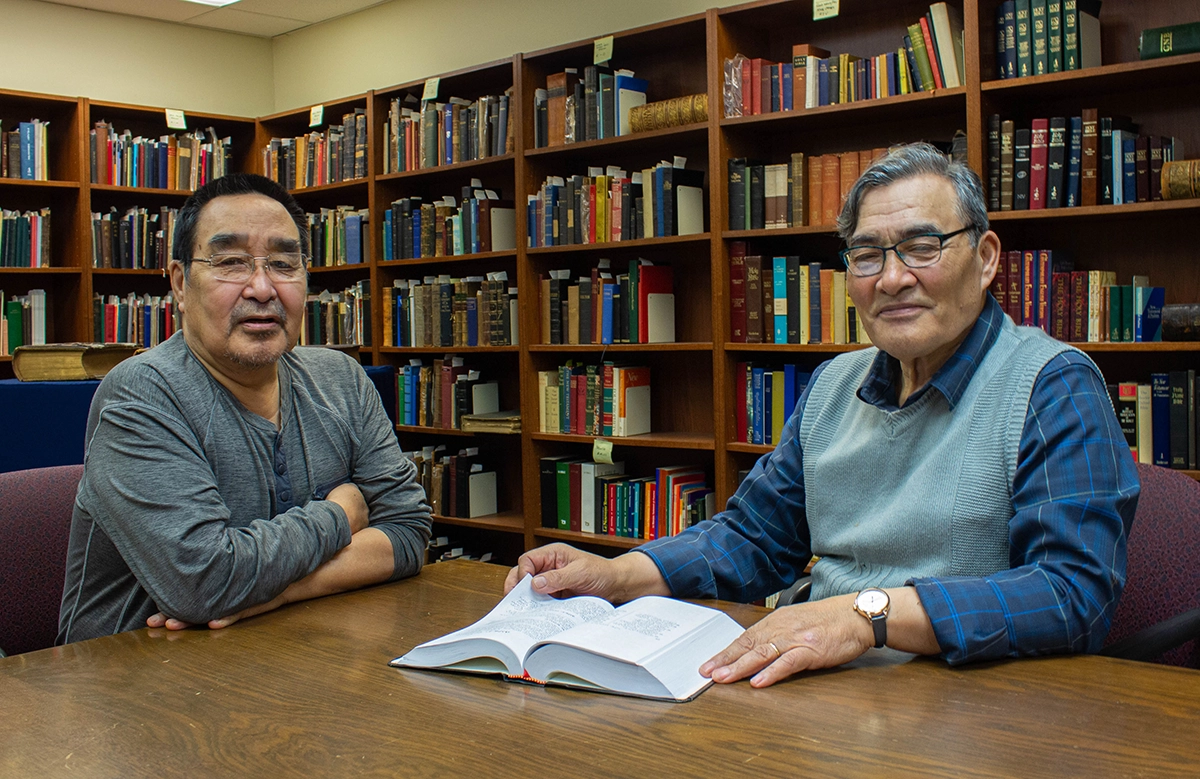
Indigenous Bible Translation Projects
The Complete Bible in Blackfoot
Blackfoot, also known as Siksiká, is a member of the Algonquian language family. Along with Arapaho, Gros Ventre and Cheyenne, it belongs to the Plains group. Blackfoot is spoken in northwestern Montana and throughout Alberta, Canada, making it one of the westernmost Algonquian languages geographically.
Parts of the Bible were first published in Blackfoot in 1890. Over the years, from the 1970s to the present, a dictionary and grammar have been completed, along with some books of the New Testament and the Jesus film.
Today, Blackfoot is spoken by 6,450 speakers in Canada. As of 2021, the registered Blackfoot population numbered 7,565, with 4,136 living on reserve in Alberta. The Blackfoot language is experiencing the fastest growth among First Nations languages in the Prairie provinces, increasing by 1,025 speakers, or 18.9%, from 2016 to 2021. The Blackfoot Bible will play an important role in preserving the language and culture.
TARGET DATE: Complete Bible translated by the 2030s.
“It’s been a real thrill to be working on this…I just love doing it. Our Blackfoot language has a lot of expression…you can almost see the beauty in it just from saying the word.”—Rosie Jane Tailfeathers, Blackfoot translator
The Gospel of Luke and Selected Scriptures in Kwak’wala
Kwak’wala is the heart language of the Kwakwa̱ka̱ʼwakw people, spoken across communities on northern Vancouver Island and the central coast of British Columbia. While portions of Scripture were translated into Kwak’wala in the late 1800s, these texts no longer reflect the living language spoken and understood today. Elders and church leaders have expressed a desire for Scripture that speaks clearly in contemporary Kwak’wala.
In recent years, there has been renewed commitment within the community to strengthen language use and pass it on to future generations. Since 2024, the Canadian Bible Society has partnered with Kwak’wala speakers in a community-led translation project, providing training and tools for Scripture translation.
The team has begun work on the Gospel of Luke, starting with 20 key stories that resonate strongly with Kwak’wala culture, along with several foundational passages for teaching, worship, and blessing. This work seeks to see God’s Word heard in Kwak’wala, shaped by local voices and shared for the blessing of the Church and community.
- Illustrated comic-style booklets
- Audio recordings
- Short Kwak’wala-narrated videos
TARGET DATE: Complete the entire Gospel of Luke by 2028.
“We’re doing something that’s valuable for the Lord and the betterment of our people…Some of the elders…they’re crying tears of joy…When I hear the Bible in Kwak’wala, I feel amazed…It’s kind of like a dream come true.”—Brody Naknakim, Kwak’wala translator
The New Testament in Anihshininiimowin
For years, the people of Kingfisher Lake have longed to hear Scripture read in their own heart language. Their faith is strong, but the absence of a full translation limits how deeply they can engage with the Bible. The Anihshininiimowin Bible Translation project was born out of this need: to bring God’s Word to life in their heart language.
The Anihshininiimowin language, spoken by roughly 12,000 people across northwestern Ontario, carries the community’s history, humour, and worldview. Translating the Bible helps preserve and strengthen the language so it can be passed on to future generations.
CBS, working alongside the Indigenous Spiritual Ministry of Mishamikoweesh in Kingfisher Lake, will continue to guide the Anihshininiimowin translation process already in motion.
To date, the team has drafted over a third of the New Testament and published Mark, and 1–3 John.
- Prayer book
- Gospel of John currently under review
- Audio for John’s Epistles in progress
The Old Testament in Naskapi
Naskapi is the heart language of the Naskapi people, spoken by approximately 1,612 people, most of whom live in Kawawachikamach, Quebec. In response to a request from the community in the 1970s, a Bible translation project was launched so that Scripture could be heard and understood in the language of the people. The New Testament was completed and published by CBS in 2007, creating a foundation for deeper engagement with God’s Word.
Since then, work has continued on the Old Testament, with Genesis, Psalms, and Exodus already published. Other books at various stages of completion include Numbers, Judges, Ruth, Jonah, 1–2 Samuel, 1–2 Kings, Ezra, Esther, Nehemiah, Job, Jeremiah, Daniel, and Joel. Judges is complete and ready for publication, and introductions are being prepared for Ruth, Esther, Jonah, and Joel.
Today, the project brings together translators, elders, and community members to ensure that Scripture speaks clearly in the living language of the people. Alongside translation, literacy and Scripture engagement continue to grow, strengthening both faith and language use within the community.
- Print Scripture portions
- Audio recordings
- Community Scripture engagement
TARGET DATE: First draft of the whole Old Testament in progress and is estimated to be completed by the end of June 2028.
“We use the Scriptures everywhere in our community; they give us hope and comfort.”—Naskapi community member
The Complete Bible In Inuktitut – Revision
Inuktitut, also called Eastern Arctic Inuktitut, is spoken primarily in Nunavut and in Nunavik (northern Quebec) by the Inuit people. It is one of the official languages in the Nunavut territory.
The whole Bible was completed in 2012, and now CBS is helping the Church revise the 2012 publication. Recent milestones include the completion of the New Testament, which is currently available through the Digital Bible Library, the YouVersion App and in print, and the creation of a Children’s Bible in Inuktitut.
- Audio recording of the New Testament done in fall 2022 and released in fall 2023.
- Old Testament 50% completed by the end of 2026
- The Mission: Literacy series -translated into Inuktitut and published in spring 2023.
Target date: Complete 50% of the Old Testament revision by 2026.
“When it was published, it was awesome to see a whole book of the Bible in our language…Spiritually, it has helped a lot in my life.”—Joshua Arreak, Inuktitut proofreader
North Alaskan Inupiaq Old Testament
With the New Testament in hand, completing the Old Testament (OT) will make the whole Bible available. Many people have come forward to be involved in the translation process, and most are volunteers, working out of a sense of calling to complete the OT in Inupiaq, for the blessing of the Church and the community. Their involvement greatly accelerates progress.
Inupiaq is the collective term for the Inuit dialects spoken in Alaska and immediately adjacent parts of Northern Canada. It is closely related to other Inuit languages across the Arctic in Canada and Greenland. There are roughly 4700 speakers. It is considered a threatened language with most speakers at or above the age of 40.
Inuinnaqtun Scripture Portions
Inuinnaqtun is one of the official languages of Nunavut.
CBS hosted an Inuit Bible translation conference in Nunavut in early 2017, and participants from the central Arctic requested help with some work in Inuinnaqtun.
The first accomplishment of the collaboration was to convert their Bible portions from the 1980s (Ruth, the Four Gospels, Acts) into electronic format and make them available through YouVersion, an online and mobile Bible app. Next, volunteers translated the Mission: Literacy stories, which were published by CBS in 2020.
Volunteers also did a fresh translation of the Gospel of Mark, which we published digitally in 2021. Portions of the new translation of Mark will be included in the new edition of the prayer book.
CBS is committed to helping them with their biggest challenge, to update the language and spelling in their translation of the Anglican Book of Common Prayer, which is mostly Scripture. Our investment is in ensuring contemporary and accurate language and preparation for printing. The book will be published by our long-time partner, the Anglican Church of Canada.
At the request of church leaders, we also helped update the language and spelling in the Inuinnaqtun translation of the Anglican Book of Common Prayer, which is mostly Scripture. Our role was to ensure contemporary and accurate language and preparation for printing. The book will be published by our long-time partner, the Anglican Church of Canada.
Western Cree Bible
Plains Cree (Y dialect) is spoken in the prairie provinces and is one of the few Indigenous languages in Canada to have a complete translation of the Bible. This translation in Cree syllabics was first published in 1862 by the British and Foreign Bible Society. It had been translated by William Mason, a missionary ministering in Norway House, and others including his wife Sophia Thomas Mason from Red River, whose mother was Cree, and their Indigenous co-workers John Sinclair and the Reverend Henry Bird Steinhauer. The translation was revised from 1904-1908 by Archdeacon J.A. MacKay and Richard Faries. This Bible has remained in use in Cree communities up to the present day. At the request of Indigenous church leaders, we published a new edition of this Bible in 2020.
Contemporary Plains Cree Scripture Portions
In the 1980s, CBS began a new translation into Plains Cree as it is currently spoken. The translation was drafted by Rev. Dr. Stanley Cuthand and portions of it have been reviewed by a group of Cree speakers based in Saskatoon. Between 2004 and 2018, we published the book of Ruth, a collection of Psalms, the book of James, and the four Gospels and Acts, all in Standard Roman Orthography and all with audio recordings available. We also produced a translation of the Mission: Literacy series of Bible story books in Plains Cree and published these in print and as e-books with read-along audio.
The Complete Bible In Mohawk
The first-ever Bible Society translation was the Gospel of John in Mohawk in 1804. In 1880, a translation of the four Gospels by Sosé Onasakenrat was published.
 From the early 2000s, CBS has been supporting Sosé’s great-grandson, Harvey (Satewas) Gabriel with translation checking, funding, and publishing the work of the team that Harvey was part of: 2 Corinthians (2001), Jonah (2002), Ruth (2005), Daniel (2005), Esther (2006), Proverbs (2007), and Genesis (2014).
In early 2020, CBS responded to Harvey’s request by helping him and his family set up this project to complete the Bible. We provided part of the funding and supported with translation checking over the past three years to bring it to completion, including the final steps of typesetting and publishing.
The project is a partnership with the Mohawk Council of Kanesatake and the United Church of Canada.
The Canadian Bible Society published the complete Mohawk Bible in 2023.
Visiting the Dedicated Bible Translators Serving Canada’s Indigenous Communities
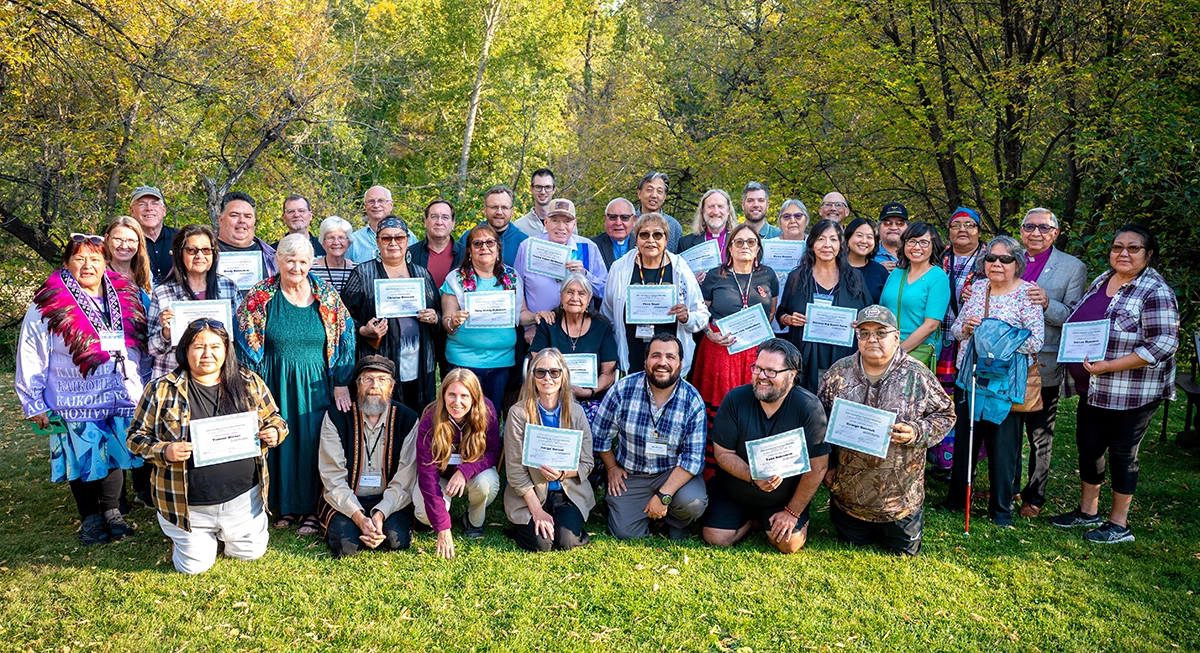
Indigenous Bible Translation Capacity-Building Initiative
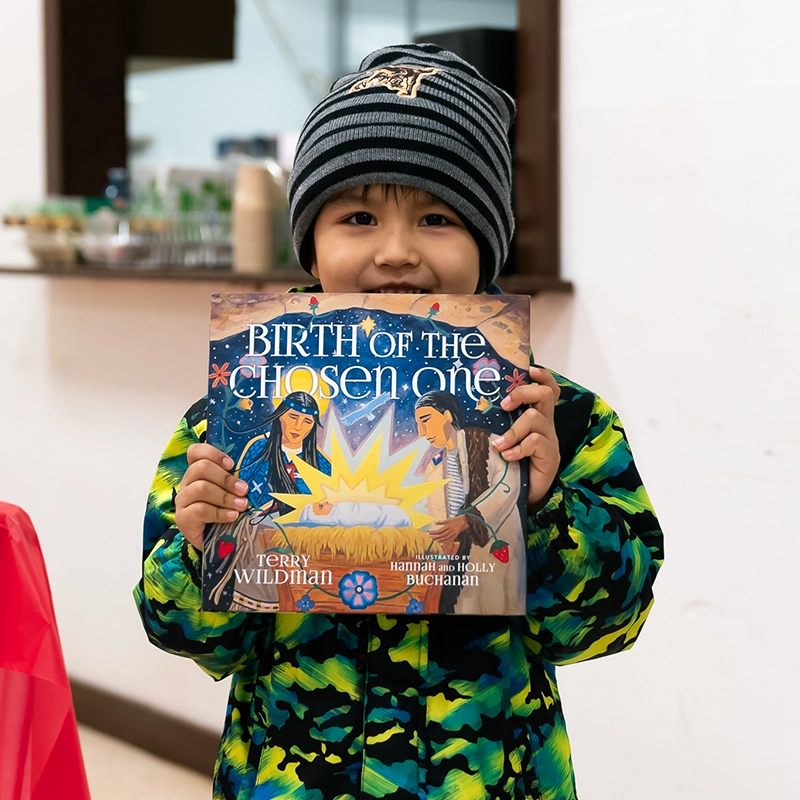
Indigenous Bible Engagement Resources
The Canadian Bible Society (CBS) is committed to making God’s Word available to Indigenous communities in their heart language. Through multi-year initiatives – including a past partnership with Crossroads First Peoples Voices and our most recent collaboration with I Am Compelled – CBS has supported Indigenous communities across Canada, including remote and Arctic regions, by providing Bibles and Scripture resources.
CBS continues to provide Bibles for youth and children, Indigenous-language Scriptures, Bible engagement resources, and home study materials – helping communities engage with God’s Word in meaningful and relational ways. Community members have received not only these resources but also encouragement and hope, as lives were touched through prayer, renewal, and moments of spiritual healing.
Hope for First Nations People
Pikangikum is an Ojibwe First Nation in northwestern Ontario. Colleen Estes, a missionary in Pikangikum for 23 years, says she has never seen such a hunger for the gospel.
“Since no outside ministries are allowed on the reserve (during the COVID-19 pandemic), the gifts received from CBS are being used at many outdoor gatherings.” Colleen couldn’t keep up with handing out the Bibles and had 22 requests within a few hours of the arrival of the shipment at her home.